
- Objectively track progress
- Return progressively with clear and measurable benchmarks for a safe comeback
Pour toute réservation simultanée (Forfait Duo ou Intégral), bénéficiez d’un test de lactate offert.
PRENDRE RENDEZ-VOUSMeloq force plates accurately measure force production and how your weight is distributed during key movements. They reveal imbalances or compensations that are often invisible to the naked eye, even when you feel in great shape.
These data help guide your training or rehabilitation plan with precision, so you can improve performance, reduce injury risk, and validate your return to sport.
The OVR Performance linear encoder measures movement speed, power, and execution quality in real time during strength or rehabilitation exercises.
It allows you to quantify training intensity, adjust loads with precision, and objectively track progress in performance or return to sport.
Idéal pour mesurer la production de force et la répartition des appuis.
Possibilité d'ajouter un programme d'entraînement personnalisé (en supplément).
Idéal pour mesurer la vitesse, la puissance et la qualité d’exécution.
Possibilité d'ajouter un programme d'entraînement personnalisé (en supplément).
Idéal pour améliorer sa performance globale.
Possibilité d'ajouter un programme d'entraînement personnalisé (en supplément).
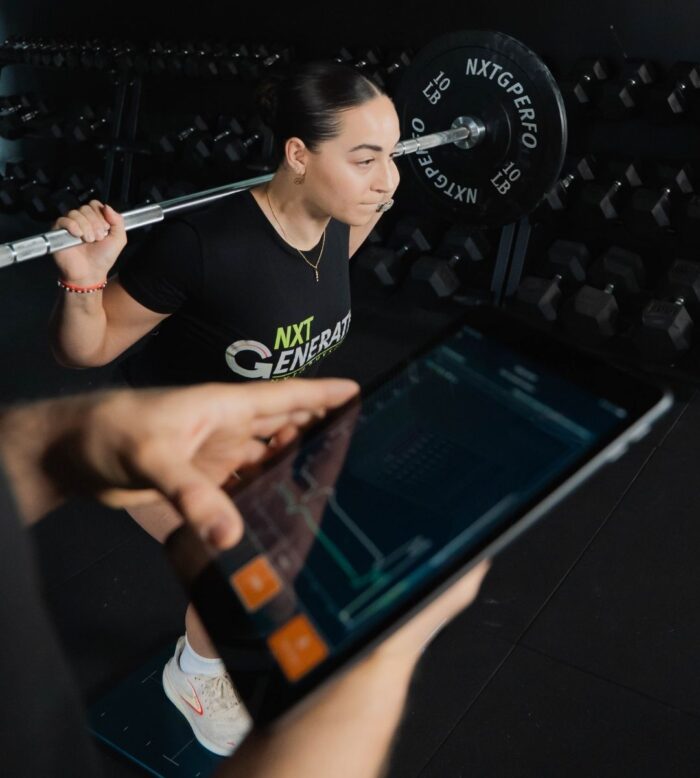
Stop guessing whether your load is too heavy to move explosively or too light to build strength. Just like heart-rate zones guide cardio training, our force plate and encoder tests define your muscular intensity zones.
The goal is simple: identify the perfect load to maximize the effectiveness of every set.
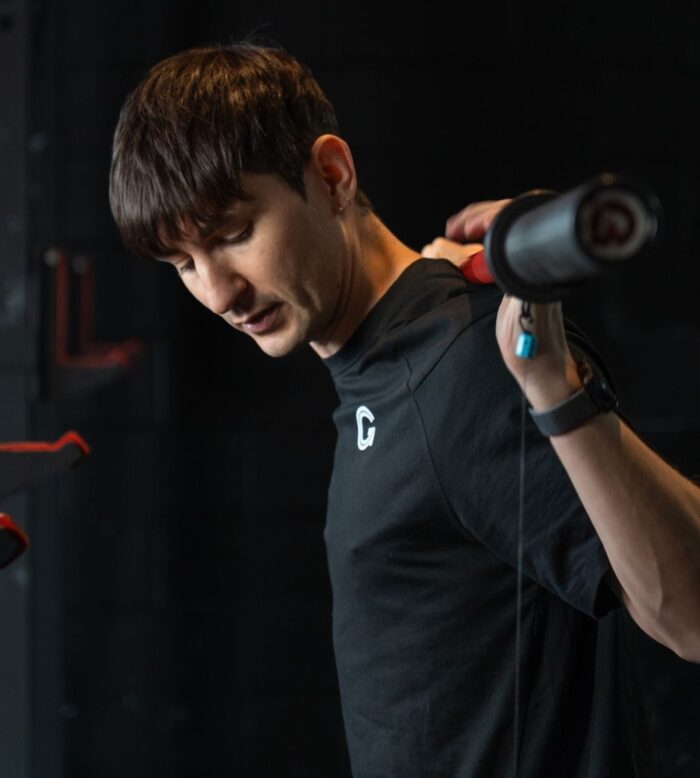
THE HYBRID ATHLETE
THE POWER AND EXPLOSIVENESS
THE ENDURANCE ATHLETE
Our tests are not simple evaluations. They are structured protocols designed to extract precise data about your neuromuscular profile. Here is how a session works with our specialists.
This test focuses on the load-velocity relationship to determine your optimal training loads.
10 minutes — Introduction to the test and explanation of the evaluation process
5 minutes — Mobility work to prepare the joints and main muscle groups
5 minutes — Progressive warm-up to activate the muscles and prepare the movements
10 minutes — Squat assessment to analyze lower-body force production and power
10 minutes — Bench press assessment to measure upper-body strength and power
10 minutes — Deadlift assessment to analyze overall strength and force production
10 minutes — Debrief and explanation of the results and data collected
The standard protocol includes the squat, deadlift, and bench press.
You can add a pulling movement based on your specific goals.
An evaluation that measures maximal force production, establishes your force-velocity profile, and highlights asymmetries.
10 minutes — Introduction to the test and explanation of the evaluation process
5 minutes — Mobility work to prepare the hips, knees, and ankles
5 minutes — Progressive warm-up to activate the muscles and prepare for jumping movements
10 minutes — Countermovement jumps without load to establish baseline power and speed
20 minutes — Series of jumps with progressively increasing loads to determine the force-velocity profile and analyze power production
10 minutes — Debrief and explanation of the results and collected data
The standard protocol includes vertical jumps with progressively increasing loads.
The protocol can also be performed with upper-body movements, such as push-ups or pulling exercises.
– Force Plate:
– Linear Encoder :
Measures the speed and displacement of a load.
Allows analysis of the force–velocity relationship and power output.
The two tools are complementary.
No. The protocols are standardized, progressive, and adapted to the individual’s level.
Loads are selected based on the person’s profile and experience.
Yes. For reliable results:
No, not necessarily.
With a linear encoder, maximal strength can be estimated from the load–velocity relationship without going to failure. This helps reduce risk and fatigue.
Execution speed is strongly linked to relative intensity (%1RM).
It allows precise load adjustments and helps target specific training zones (strength, power, speed).
The vertical jump is an excellent indicator of:
An asymmetry refers to a difference in force production between limbs. A small asymmetry is normal. However, larger differences may be linked to a higher risk of injury due to compensation and can lead to a loss of performance.
Yes. They allow you to:
A report may include:
Optimize your team’s performance without leaving your facility. Whether you own a training center, coach a sports team, or lead a group of dedicated athletes, our mobile team can bring the full technology setup directly to you. From power analysis with force plates and linear encoders to VO₂max and lactate testing, we transform your gym into a performance lab for the day. It is the ideal opportunity to evaluate player asymmetries, define precise training zones, and provide your community with a unique science-based performance experience.
Contact our team to learn more by filling out the form below.